
Counselling Children & Young People - Level 5 Diploma
"Don’t laugh at a youth for his affectations: he’s only trying on one face after another till he finds his own." – Logan Pearsall Smith

Tutor Insight
Over 20 years ago, armed with my shiny new Level 4 certificate, a background in secondary school teaching and unbounded enthusiasm, I decided that working with children and young people (CYP) was going to be my thing. I had loved being a form tutor; listening to the children and figuring out practical ways to help them had been my forte. But I recognised that often they needed more than a helping hand. They needed an empathic connection with someone, a safe space to express emotions, and an understanding of the trials and tribulations, large and small, they experienced.
I had only a limited understanding of how to provide this – hence the Level 4 qualification – but afterwards, there being no training focused entirely on working with this age group, I had to rely on good supervision, a willingness to learn and lots of feedback from those early young clients. Happily, there are now a growing number of trainings available to those who decide, like me, that working with children and young people is their thing. I want to give you an insight into our course here at Kent Counselling Training and how it can furnish you with the exact skills, knowledge and self-awareness you need to ensure you feel confident and well supported to practise in this area.
"Our students learn to recognise when these needs emerge and develop ways of responding to them that are age-appropriate, ethical, and effective."
‘We, Me, Us’ Model
At KCT, it is our firm belief that a good training course will put the needs of the client at the centre of the work. That’s no different when training to work with CYP. We have developed the ‘We, Me, Us’ model, unique to our training, in order to illustrate these needs and how we work with them in the counselling room.
‘We’ is what all CYP bring to counselling to some extent – things such as what it’s like to be a CYP in the world today, attachment and the systems around them (school, home, friendships etc.)
‘Me’ refers to the individual client who may be bringing neurodivergence, trauma, or difference, for example.
‘Us’ refers to what is offered by the counsellor as part of the therapeutic relationship – for instance, therapeutic play, the BACP Core Competencies, and an understanding of safeguarding.
All of these aspects weave through the work and form the basis of our training so that our students learn to recognise when these needs emerge and develop ways of responding to them that are age-appropriate, ethical, and effective.

Teaching Style
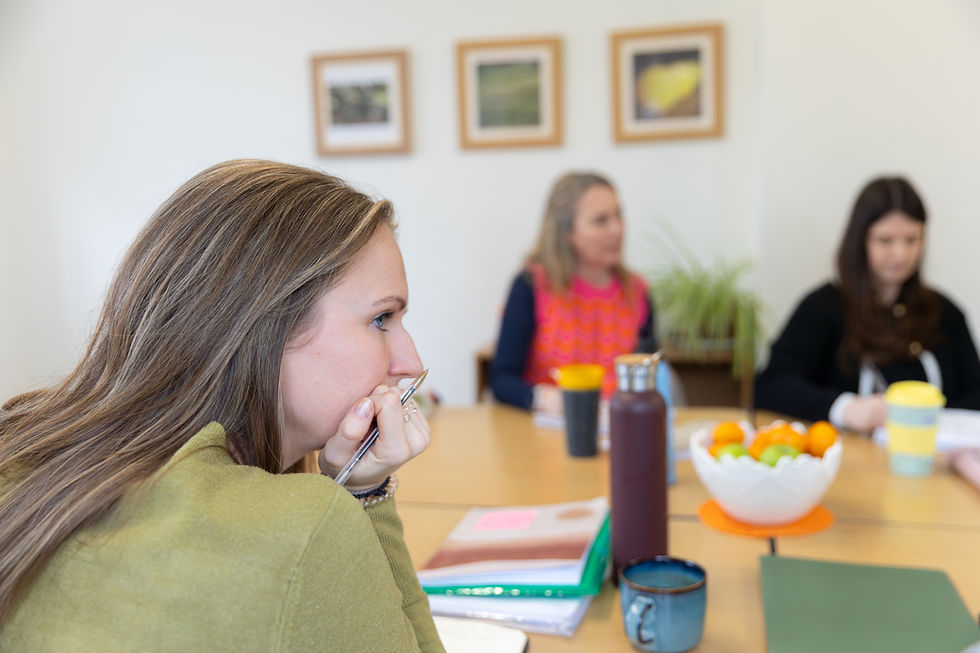
Students are often concerned about how they will learn before beginning a training course. As tutors, we recognise that our students will have different learning styles and so we aim to make the course as experiential as possible. It’s not just chalk and talk! We actively encourage you to discuss your learning and experiences with each other and us and there is plenty of opportunity every session for skills practice and supervision groups. Sharing information and new understanding is great for all of us and we want you to become professionally curious practitioners. There are also lots of opportunities to be creative, including a whole section looking at play and its importance to CYP. You don’t have to be an artist, but being open to experimenting with working creatively is a really important part of being able to communicate and connect with CYP and it can be fun too!
Working Effectively & Safely
Of course, there will be plenty of theoretical learning around attachment, child development, safeguarding and risk, mental health, neurodivergence and diversity, all of which form the bedrock of working effectively and safely with this age group. We will encourage you to think about how these topics apply to your practice and support you to develop your own critical thinking and practical skills. And don’t worry if you are unsure about how to find that all-important placement. We support you with this at the start of the course and have links to organisations that can offer opportunities.

Robust Training
You might be thinking that this sounds like a lot and it is – good training in working with CYP should be robust and thorough – but we also want you to enjoy the course and to value your own part in supporting your clients when they are vulnerable. With this in mind, looking at your self-awareness is an important consideration that runs alongside all the learning you’ll do. With modules on exploring your own inner child, self-care and sharing best practice, we aim to support you in sustaining yourself and celebrating the successes you have with your clients.
Find out more
If this all sounds exciting – and, we know we’re biased, but counselling CYP really is the best job in the world! – have a look at our information page on the Level 5 CYP qualification. If you have any questions, we’d be delighted to answer them. You could be the very privileged person who supports a young client to truly discover who they are and what they want, and who cheers them on when they are able to go out into the world with the confidence that comes from being authentic. Your skills and understanding could enable them to keep trying on faces until they find their own. We look forward to your application.


Comments